This is the home of serious fucking journalism.
Herein, you can read plays, witness old photos, and browse several years' worth of archives. Readers may employ the slow-moving email contact to speak with the author, about whom more can be learned by clicking here.
The short version is this: I am 25 years old and I live very far away from you, where I teach English. I like girls, monkeys and Shakespeare. My hobby is talking shit. Finish.
These are my peeps who maintain web operations:
American Demigods,
Fancy That,
Man Cutting Globe,
Notext.org,
oswald.nu,
Pussy Ranch,
Same Day Different Rat,
Sen. Barack Obama,
Spaceinvader Orchestra,
WMUR.
These are web sources run by people I do not know well but to whom I feel I can safely recommend your gentle senses:
Boneyboy,
Cordelia's Kitchen,
Daily Kos,
Fametracker,
Funny Paper,
Neil Gaiman,
MarkCity,
MoveOn.org,
The Morning News,
Penn Avenue,
Paint a Vulgar Picture,
somedisco,
Spacekadet,
This American Life,
This Modern World,
WEFT 90.1 FM.
Finally, you may descend upon my Amazon wish list like the howling Bacchae.
Older entries of I woke up in a strange place are listed below. They discuss matters including Manute Bol, the Chinese space program, monkeys and very little else. You may read them at your leisure, in the order that follows or in that crazy freestyle of yours.
The present series, in which our protagonist up and moves halfway around the world to Japan:
February
January
December
November
October
September
August
July
June
In which our protagonist finds himself in the employ of a rabbi, working as a ghostwriter:
May
April
March
February
January
2002
December
In which our protagonist is really, really unemployed:
November
October
September
August
July
June
May
April
March
February
January
2001
December
November
October
September
August
July
010622 - 010619
In which our protagonist moves to the big city and finds himself employed at a global conglomerate, leading to a series of infantile but nonetheless satisfying acts of aggression:
010615 - 010611
010608 - 010604
010601 - 010529
010525 - 010521
010518 - 010514
010511 - 010507
010504 - 010430
010427 - 010423
010420 - 010416
010413 - 010409
010406 - 010402
010330 - 010326
010323 - 010319
010316 - 010312
010309 - 010307
019223 - 010219
010216 - 010212
010209 - 010205
010202 - 010109
010126 - 010122
010119 - 010115
010112 - 010108
010105 - 010102
2000
001229 - 001224
001222 - 001218
001215 - 001211
001208 - 001204
001201 - 001124
001124 - 001120
001117 - 001113
001110 - 001106
001103 - 001030
001027 - 001023
001020 - 001016
001013 - 001010
001006 - 000927
In which 'college' reaches its explosive conclusion:
1999
December
November
Fall
In which things go fairly well:
May
February
January
1998
December
November
October
June
May
April
March
February
In which our protagonist returns to college, reluctantly, other plans having been scuppered:
January
1997
December
November
October
September II
September I
And that's the end of it.

030624 At first, I was only telling my students my bowling average and high score if they asked about it. These days, I figure, fuck it, who cares if they ask? I'll tell them anyway.
I had a tough roster of students today: mostly teenage girls, and a man-to-man lesson in the evening with Fortress Genyuu, a genial middle-aged man with virtually no language skills who retains next to nothing from lesson to lesson and, despite having a good sense of humor about it, looks like he could beat anyone in Japan's ass and may be thinking about doing so after the lesson. I had him draw a floor-plan of his house the other day in a group lesson, but I had no idea what to do with him in a man-to-man lesson, especially seeing as how I'd already told him about my bowling average the day before. (It turned out okay: this time, we had a spirited discussion about days of the week and things you find in kitchens.) It's the teenage girls who really put you through the wringer, though:
ERINA'S DREAMERINA: "I am tired! I am so worried! Soon I am taking entrance examinations. Very hard! I will go to foreign language university so I can realize my dream."
TEACHER: "That's a very good phrase! What is your dream?"
ERINA: "I must learn many languages! I will learn Chinese and French. I want to become a teacher abroad. I will teach to the poor people how to speak English, in the poor countries. But I have to know the language of the poor people! So I must know very many languages, because I do not know which one is the right one for them!"
TEACHER: "Well, that's a very nice dream."
ERINA: "Thank you!"MIKI'S LAMENT
ERINA: "Miki! What is your dream?"
MIKI: "My dream?"
ERINA: "Yes! To realize your dream!"
MIKI: "I don't know."
ERINA: "You have no dream?!"
MIKI: "Dream?"
TEACHER: "A dream can be like a big plan for the future, something you want very much."
MIKI: "I want to get married."
ERINA: "Ohh! Yuuske is my boyfriend! Do you think he is cute?" (Indicates pictures on notebook.)
TEACHER: "I'm not really qualified to say, Erina."
ERINA: "Miki, do you have a boyfriend?"
MIKI: "No." (Begins to blush quite severely.)
ERINA: "You don't?"
MIKI: "No."
ERINA: "Ohh!" (Looks pointedly at the teacher.)
TEACHER: "What?"
Hasty segue notwithstanding, I managed to teach a decent lesson about the subtleties of using "too (hot/cold/etc)" and "not (hot/cold/etc) enough".
ERI'S CAREER CHANGEERI: "I used to be a dental assistant. Now I am a shop worker."
TEACHER: "Why did you quit your job as a dental assistant?"
ERI: "Too dirty!"
She has a point. I don't know how the bad-teeth stereotype got affixed to the English, because I have seen some profoundly fucked sets of teeth among the Japanese.
I should write a few words about our textbooks and teaching system. Students are divided up by level of ability: absolute beginners are 7C, followed by 7B, 7A, 6, 5, 4 and so on. Native fluency is level 2. (Who is level 1? Teachers? God? No one really makes it past 3, so I don't know if it has ever been answered.) There isn't much to do with 3's and 4's other that shoot the shit about baseball or whatever else they want to talk about. (I overheard another teacher leading some 4's in a discussion about ethnic cleansing the other day. Man, I stick to baseball.) With the other levels, you check their file to see what lessons they've had, and you try to find one that's open in common among all of the students (anywhere from 1-4 in each class), or one which they haven't done recently. (There are a ton of 7A students who've done every lesson three or more times but still aren't good enough to level up.) In practice, most teachers only have 5-10 lessons from each level that they're willing to do, but that works out fine, because students are randomly assigned to different teachers every time they come. So, you wind up with a fair amount of students that you've had before, but they've usually had other teachers since you last taught them. Each page of the students' texts has a story, a picture and some grammar point. You use that as a springboard to plan a lesson. There are some that I never get to use (the pseudo-Muhammad Ali one in 7A has always been taught before I get to it, as has level 6 #8, wherein you just have the students fill out a questionnaire about sleep and dreams, and then they chat about it when they're done), but there are a few that I've made my own, such as 7A #43 (how to complain about things), 7A #49 (little vs few, much vs many), 6 #12 (look, feel, taste, hear, smell), 6 #20 (comparative adverbs), so on and so forth. I do think the textbook was designed with the idea that students would be doing these lessons in order, but with the random assignment of teachers and classmates each time out, it's just not possible.
The textbooks are brilliantly outdated. They were written for Spanish ESL students a little over twenty years ago, and for some reason, this Japanese school bought reproduction rights to them. All teachers catch the frequent references to the Soviet Union right away (you get to compare its size to that of East Germany at one point), but there are many hidden delights to be found deeper within, such as the exercise where students are asked to compare the abilities of celebrities (Example: "OJ Simpson is a faster runner...") or the photograph from a record store where Bananarama, U2's "October" and the Police's "Synchronicity" are clearly visible on the new releases shelf. The students seem completely oblivious to it, fortunately, although a handful of the stories do feature characters explicitly informing each other that it's 1983. There's one story where a woman announces that she is going to leave a party because she's almost too drunk to drive, and everyone else harasses her, so she stays, has a few more drinks, and then leaves to drive home. That's just the background of the story, mind you - it doesn't end with a cautionary tale about drunk driving or anything, they just finish the party and leave, with the woman chastened for her party-pooping ways.
On a non-academic note, I found a pair of excellent Engrish t-shirts for 500 yen apiece at a sidewalk sale during my lunch hour. If I return to the United States without an unstoppable armada of bat-shit crazy t-shirts, I have failed. That is my position.
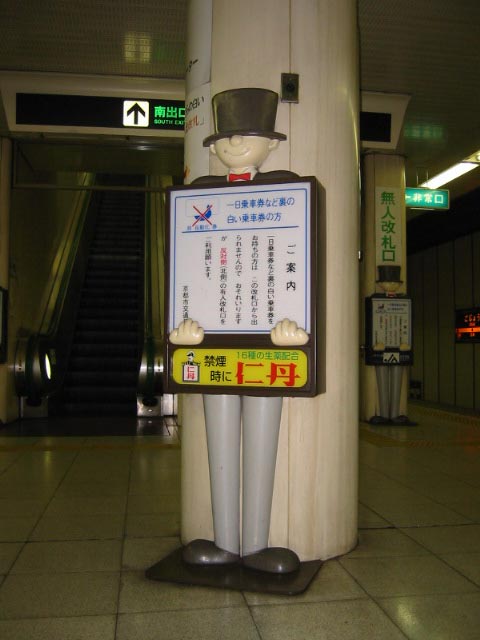
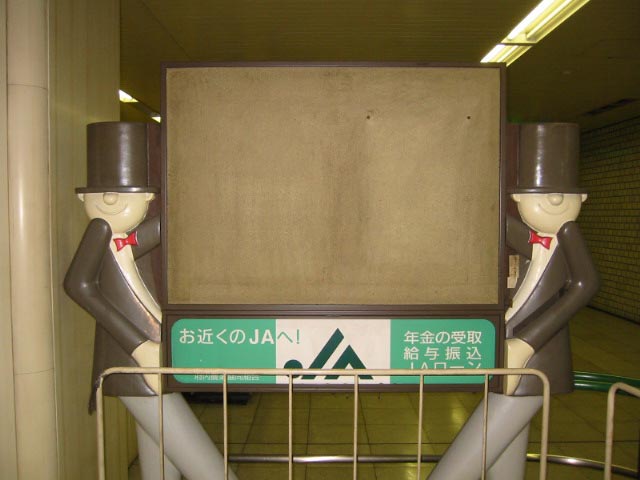
These dapper fellows can be found in one of the subways near my apartment. The train lines are all privatized, run by separate companies, so each has its own decor. Some vary from the norm more than others. Hankyu, my regular line, just has some panda-porn advertisements for tourism in Kobe. I work at a different school sometimes on Thursdays, though, and these guys are all over that train line: a solid forty or so at each subway station. To deny how awesome they are is sheer madness.
030619 I am keeping my cool, which is the most important part. Yesterday's sound and fury notwithstanding, life is good, life is relaxed. I am in demand as a teacher and I am getting better at it. Today was my day off. I had agreed to go to Nijo Castle with a housemate, but the rainy season was in full swing when I finally emerged from my bedroom, and I was looking great in my black and silver basketball shorts, so I decided to stay in and lounge around for most of the day. I'm planning to do most of my tourist-ing in the fall, when the heat and humidity abate. For now, I am content to keep my cool.
In the evening, I did some wandering. After a trip to Tower Records, I came upon the 99 Yen Shop for the first time. It is a glorious place, dramatically unlike its dingy American equivalents (dollar stores). Everything from the local supermarket was there, but for the low cost of 99 yen (roughly 85 cents) instead of 300 or 400 yen. It was quite nice; I had to keep reminding myself that if I could see it, I could afford it, because absolutely everything was only 99 yen. The only real drawback was having to listen to an insane theme song on the ceiling muzak in which a high-pitched voice chanted "99 yen" over and over again. The local supermarket plays only the Beatles (and obscure tracks, too, from lesser-known masterpieces like "Yes, It Is" to their absolute nadir, "Girl", but no solo tracks, as far as I can tell, leaving no possibility of the magic that might occur shopping for cold turkey while listening to "Cold Turkey"). I feel bad about abandoning the supermarket, but that's what I have to do. 99 Yen Shops are not to be fucked with. How can they offer such low prices? With no reason whatsoever, I choose to believe that it's something or other to do with the yakuza.
Remember the good old days of Doritos?
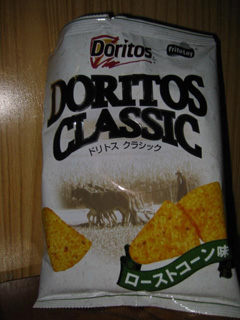
Yes, many people forget about the hard-scrabble, working-class origins of this popular corn chip, but old-timers fondly reminisce about the days when Doritos were the product of one man's dream, one man's hard work, and if he didn't make the trip to the market that week, then everyone would have to do without until he did; when Doritos, like our lives, were simpler, less flashy, the pride of a small-town farm community; and when Doritos, like our lives, didn't have that sketchy Mexican air about them.
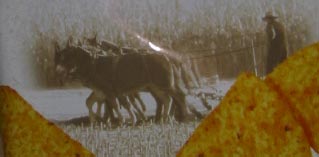
What's that? You don't remember those days? Strange, neither do I. In many ways, Japan is not another country as much as it is a parallel universe. Of course, I bought the Classic Doritos for 99 yen and brought them home for dinner. As the package promises, each chip is dusted with the all-natural flavor of the back of a sweaty horse, which is to say that they taste sort of like less greasy Fritos. They're kind of thick, also.
More futuristic landscapes for kids:
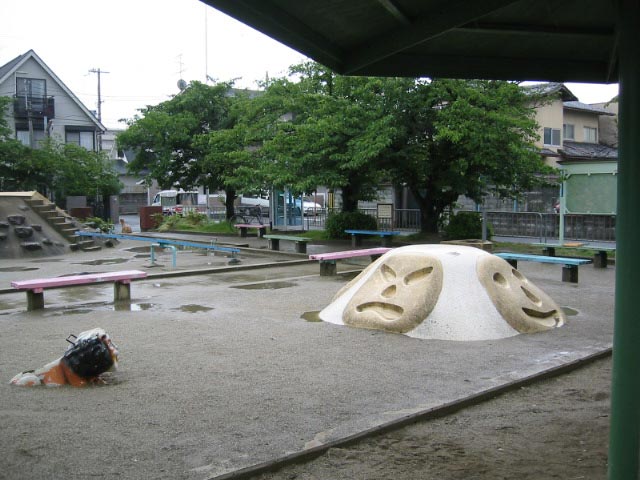
Why is the lion half-buried? Why is the unhappy face turned towards him? What does this mean? Am I the lion? No one tells me anything.
030617 As some of my friends know, when awakened by the phone, I will agree to almost anything in the interest of getting off the phone and going back to sleep. I awoke with horror yesterday morning, realizing that, in order to get the Foreign Personnel Office off the phone, I'd agreed to work a double-shift at the language school. Who takes advantage of a sleeping man like that? A single shift is bad enough, as that gang of heartless manipulators should well know. The work day at a language school is a process of gradual derangement. Everyone you meet speaks fragmented English, and basic concepts of proportion and order do not exist ("My hobby is reading newspaper and climbing mountain", said Nakao), leaving you as the sole bulwark of the reason you remember existing in a land and a life far away from this tiny classroom. You have to keep reminding yourself that these are grammatical errors, not pronouncements of fact. Eight lessons leaves you at your limit but able to walk away under your own power. Anything beyond those eight is a serious risk to your long-term mental health. As I expected, things grew strange as the day wore on. My eyes were glassy, my tie half-cocked. A student, asked why he wanted to learn English, gave a ten-minute, non-stop, completely incoherent dissertation on the study of law throughout Japanese history. Another student announced that she wanted to learn English so she could "marry a foreigner and bear half-Japanese, half-foreigner babies". The usual list of questions - where am I from, do I have a gun, do I have a girlfriend, what do I think about Japanese women - seemed to be coming from somewhere above me, spoken simultaneously on the high-end and the low-end of the audio spectrum, but not the middle. Another woman, dressed seductively, named Mami, announced that she wanted to be a screenwriter, but when she tried to write a scenario, she couldn't sleep because she was always thinking of ideas, so she gave that up and started working at a tire company.
Although I had my umbrella with me, I left it at school and walked home in the rain.
030611 I am late with this news, but I didn't want to let it pass without comment. Last week, the American Film Institute, in its ongoing quest to promote awareness of the American Film Institute, issued its list of the 100 Greatest Heroes and Villains in the last century of cinema. I decided to see who made the list, and I was interested to notice that Mahatma Gandhi came in #22, five spots behind Dirty Harry. Although Gandhi did out-pace Superman, Moses, and Lassie, he got his ass handed to him by Rocky Balboa, a full fifteen spots ahead at #7. This, it must be said, puts the final nail in the coffin for passive resistance as a good-but-not-great form of ass-kicking.
In another hotly-contested race, Man came in two spots behind The Shark on the Villains list. Man can only stare at his opposable thumbs and wonder what might have been until the next century's list comes around.
Wednesday and Thursday are my weekend, so life is chill for me at the moment. Yasuhiro, one of my star pupils, informed me in class on Monday that the rainy season would begin the next day. Sure enough, it did. I became convinced that Yasuhiro was some kind of sorceror, and hinted as much in class the next day. Yasuhiro nodded and said "Yes, I saw news report that said would rain tomorrow, so I thought, this is rainy season." Way to ruin the mystique, Yasuhiro. Evidently, it's going to be raining for the next month or so, and then it will become bastard hot for a couple of months.
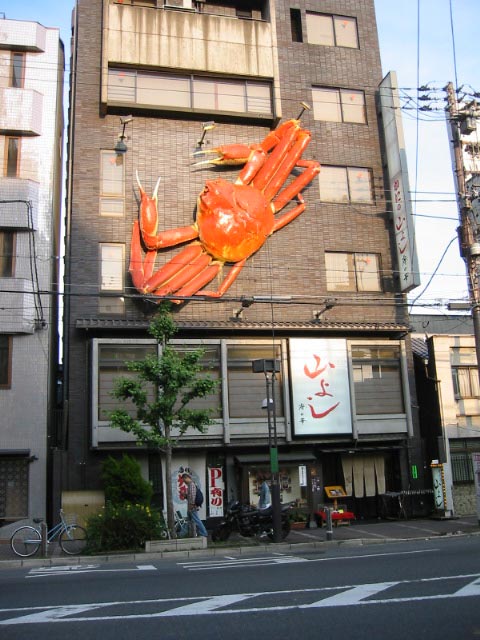
I've been informed that yesterday's giant monster was a crab, not a lobster. Seven years of not eating meat has blurred the distinctions between the more consumable members of the animal kingdom. Ah, so it goes.
Here is another picture game for you. Please examine the following advertisement, hundreds of which can be found in the subways of Osaka. Who is the shithead in this picture?
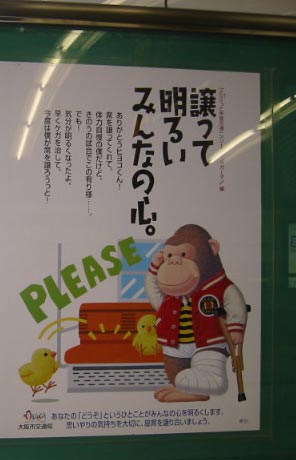
You probably thought that the baby chicken who's jumping around and making a ruckus was the shithead. As it turns out, though, the other baby chicken is the shithead, because he is not offering his seat to the injured, college-educated gorilla. I know, it fooled me, too, but once you think about it, that's the only explanation. The gorilla is apparently under the impression that the baby chicken holds military rank, because he is saluting the chicken. If you look closely, you can see that there is a band-aid on the gorilla's cheek, so he may have suffered a head wound to go along with his broken leg, and his judgment may be impaired. Tough times. There are some things about life that they just don't teach you in college, and I think the gorilla has found out the hard way. Still: does this poster express concern for the handicapped, or for cool varsity jackets?
I wish I could read Japanese.
030611 I had an unusually large amount of new students yesterday, so I was able to acquire some new data for the ongoing Where Am I From? project. Results skewed close to their historical distribution. One student said New Zealand ("I don't know"), one said Canada ("You seem kind"), two said America ("I don't know", "You look American"), three said England ("You have golden hair" (!), "You are smart", "I don't know"), and four said Australia ("All teachers are from Australia", "I saw Australian and you look like him", "You are tall", "You are handsome").
One drawback to the otherwise pleasant life afforded by residence in Kyoto is the strange lack of crazy t-shirt slogans. T-shirt spotting was the greatest joy of my days in Osaka, my first port of arrival in Japan. People mostly dress in modern outfits here, but for whatever reason, their shirts are usually blank. So it goes. My all-time favorite was on a train in Osaka, on my way to my first day of training. A woman in her twenties wore a tight t-shirt, with the words stretched across her breasts:
SYMBOL OF FARM INDUSTRY
I nearly missed my stop.
But life is good, life is calm. I am gradually expanding the list of foods that I can eat from the local grocery store. It's not quite at double-digits yet, but I think I am hitting the basic nutritional minimums, so that's a relief. I will be able to experiment a little more once my first paycheck arrives. (When you're living on savings, you can't afford to blow 500 yen on a dinner which, regardless of what is shown on the package, may well have fish eyeballs in it.) I am learning not to make purchasing decisions based on the relative enthusiasm of the characters on the packaging, a very important lesson that I struggled with for quite some time. (You wonder if the Calbee pig-looking guy really believes in those chips.) It's widely known that the Japanese are at the vanguard of doing crazy shit with fish, but I didn't realize that this country is also the experimental frontier of baking. They are really quite good at it, offering pastries seen nowhere else, and bakeries are second only to vending machines for sheer ubiquity in some areas. There's a bakery next to my school, and we have to pass it for a second every time we walk up the stairs from the teachers' room to class. Of course, I've had a few profoundly disgusting pastries as well, but for the most part, they are reasonably priced and delicious.
A word about 'delicious': it's been interesting to notice that certain adjectives and adverbs have an almost totemic importance to lower-level students. They learn one way of describing a thing, and they stick with it. Someone taught most of these kids 'delicious' early on, and now everything that tastes okay is 'delicious' to them in role-plays. Yesterday, a steak, a cup of coffee, and some salt were all described as 'delicious'.
A final question:
Why is everyone so calm?! A giant lobster is on the loose! Run, you fools! Run!
030611 When asked to guess where I am from, here are Japanese students' top five responses, along with the reason most frequently given for the choice:
5. New Zealand ("I have friend in New Zealand")
4. Canada ("You look nice", "You smile", "I go to Canada")
3. United States ("You are very big", "You seem relax", "I like America")
2. Australia ("All teachers are from Australia")
1. England ("You look like gentleman")
England is the winner by a mile (and that's always the reason they give). None of the others even come close. I do get a little annoyed with the ones who choose Australia, because they're avoiding the question (no other reason has ever been given for that choice), and thereby screwing with a valuable scientific inquiry. It's true that nearly 90% of the other teachers school-wide are from Australia, but I don't think our branch has more than one or two, due to some quirk of dispersal.
Here is a picture from my old neighborhood, Juso, in Osaka.
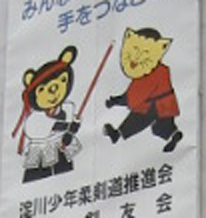
BEAR: Here I come!!
LION: I can't even believe you're going to step to me with that pole.
BEAR: I know how to use this! I will win the ice cream.
Okay. Now, guess where those fighting chums are found.
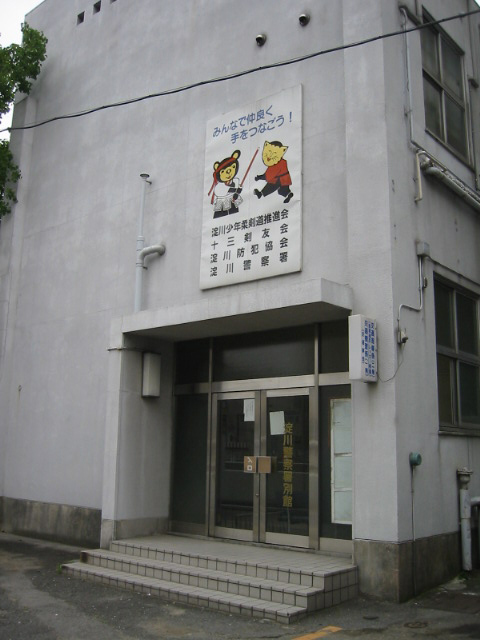
If you said "the police station", you are probably a crack addict, but in this instance, you are right, and no one can take that away from you. That is the local police station in Juso. Criminals are warned: there's an agreeable bear with a pole in these lands, so watch the fuck out.